
Joyfully and Successfully Cook with Kids
In this section, learn strategies to make cooking and eating nutritious and delicious recipes with kids fun and achievable – and maximize opportunity for changes in behavior and excitement for nutritious food.
Taken together, these practices help create an environment where every student feels confident, capable, and connected while cooking, resulting in a greater willingness to try new foods.
Cooking with students is most enriching and effective when it’s joyful, sensory, and low-pressure.
Preparedness is key to managing a smooth-running, hands-on cooking classroom.
> Set students up for success by labeling cabinets and drawers so tools and ingredients are easy to find, printing recipes for them to follow (we often put them in clear sheet protectors to guard against spills), and setting out equipment and ingredients ahead of time.
> Use real kitchen tools whenever possible to foster autonomy and help students build transferable skills they can use at home.
> Break recipes into smaller tasks that can be tackled in stations to manage group size—smaller groups create space for more hands-on practice, one-on-one support, and deeper learning.
> Practice good hygiene with students, including hand washing and covering coughs and sneezes.
Taken together, these practices help create an engaging environment where every student feels capable, confident, and connected while cooking.
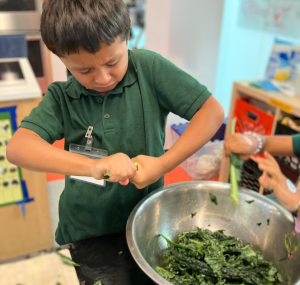
Cooking with students is most enriching when it’s joyful, sensory, and low-pressure.
> Foster this environment by inviting students to explore ingredients and tools with all their senses—smelling fresh herbs and feeling the textures of different fruits and vegetables.
> Give them real, age-appropriate tools and tasks so they can work with confidence and feel trusted as contributors in the kitchen. Even the youngest chefs can help with rinsing and scrubbing produce, tearing greens into bite-sized pieces, mixing a salad, or shaking a jar of dressing.
> Keep the experience exploratory and collaborative: ask questions, notice discoveries, and help students see how their effort and care come together in a shared, delicious result.
Resources for cooking with kids:
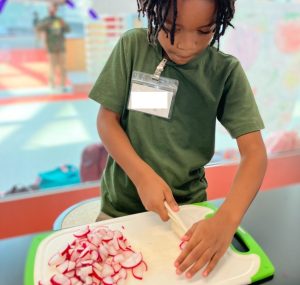
Cooking allows for rich opportunities to make applicable connections between real-life experiences and classroom content. When students cook, they practice math through measuring, explore science through observing changes in ingredients, and build literacy as they read and follow recipes. Cooking also supports social-emotional learning—encouraging teamwork, communication, awareness about different cultures/traditions, and reflection with their peers.
The FoodPrints curriculum intentionally connects cooking to what students are learning in the classroom across multiple subjects.
> Focus on Math: Scaling Recipes. This 5th grade lesson helps students understand how and why cooks adjust or scale recipes. By working with different units of measurement, students explore equivalencies in the kitchen. The accompanying recipe, Granola Bars, incorporates many fractional measurements, giving students a hands-on opportunity to practice multiplying fractions while making a delicious snack.
> Focus on Science: The Importance of Photosynthesis. In this lesson, 3rd graders learn about the process of photosynthesis and its importance to all living things. Since the focus is on leaves providing food for the plant, the connected recipe, Tuscan Kale Salad, features a tasty leafy green as its main ingredient. This helps students make the connection that the vibrant green leaves they’re eating owe their color—and their life-sustaining power—to chlorophyll. By tasting and handling kale, students can see firsthand how chlorophyll captures sunlight to fuel photosynthesis, supporting both plant growth and the food we enjoy.
> Focus on Geography: Mapping the Garden. The purpose of this 1st grade lesson is for students to explore why people use maps, how maps help us, and the different types of maps people use. Students then make the connection that recipes are like maps—both provide directions to reach a desired destination. One of the connected recipes, Sweet Potato Biscuits, invites students to “follow the map” of a recipe step by step, discovering how careful direction-following leads to a warm, delicious result.
> Focus on Culture: Exploring Food Traditions. This lesson allows students to study and appreciate food traditions from around the world, deepening their understanding of how food reflects culture and identity. The connected recipes—Aloo Palak, Biryani, and Colcannon—highlight diverse global cuisines and invite students to explore the stories, ingredients, and traditions that shape each dish. Through cooking and tasting, students discover that while ingredients and flavors may differ, food is a universal language that brings people together.
Seasonality in cooking means eating foods that are harvested at the time of year when they naturally grow best in our region. The foods we grow locally change with the seasons—juicy tomatoes ripen in summer, crisp apples appear in fall, hearty root vegetables thrive in winter, and tender greens flourish in spring. When we eat with the seasons, we enjoy produce at its freshest and most flavorful while learning how the time of year shapes what’s available locally. Understanding seasonality helps students connect to where our food comes from, how it grows, and the natural rhythms that guide what we eat throughout the year.
> Learning about seasonality through cooking allows young learners to build stronger connections to their local environment and the rhythms of the natural world. By tasting and preparing seasonal ingredients, students experience firsthand how flavor, texture, and availability change throughout the year. Cooking with seasonal produce also encourages curiosity—why are strawberries sweetest in spring, or why do we eat more soups in winter?–and naturally incorporates a wide variety of produce items throughout the year. These lessons nurture appreciation for local farms and ecosystems, strengthen observation and critical thinking skills, and inspire lifelong habits of eating with the seasons.
> Cooking with the seasons is a natural way to support and strengthen local food systems. By using ingredients that are available locally at different times of the year, we help reduce the distance food travels, encourage small farmers to keep growing for their communities, and support a more equitable, sustainable, and resilient food system.
> Recipes that Showcase Seasonality:
Spinach Pesto Pasta with Spring Peas: Tender spinach and sweet spring peas work together to capture the essence of spring: fresh growth, bright flavors, and May strawberries are seasonal favorites. Spring reminds students how seasonal changes bring new foods and flavors to enjoy.
Summer Ripe Greek Salad: Juicy tomatoes and refreshing cucumbers shine in this vibrant, flavorful salad that celebrates the best of summer produce. These sun-loving vegetables do best in warmer temperatures, emphasizing to students how summer heat brings fresh flavors and bold colors to our plates.
Colorful Kale Salad: Incorporating crisp fall apples and hearty kale, this vibrant salad celebrates the flavors and colors of the autumn harvest. These ingredients are ready to harvest as temperatures cool down, showing students how fall crops bring sweetness and crunch to seasonal cooking.
Winter Vegetable Miso Soup: This warming vegetable soup features flavorful and comforting root vegetables, providing nourishment during winter’s coldest months. Even though we don’t typically associate winter with growing produce, these winter crops thrive underground, storing energy and sweetness, and helping students understand how seasonal foods support our bodies throughout the year.